
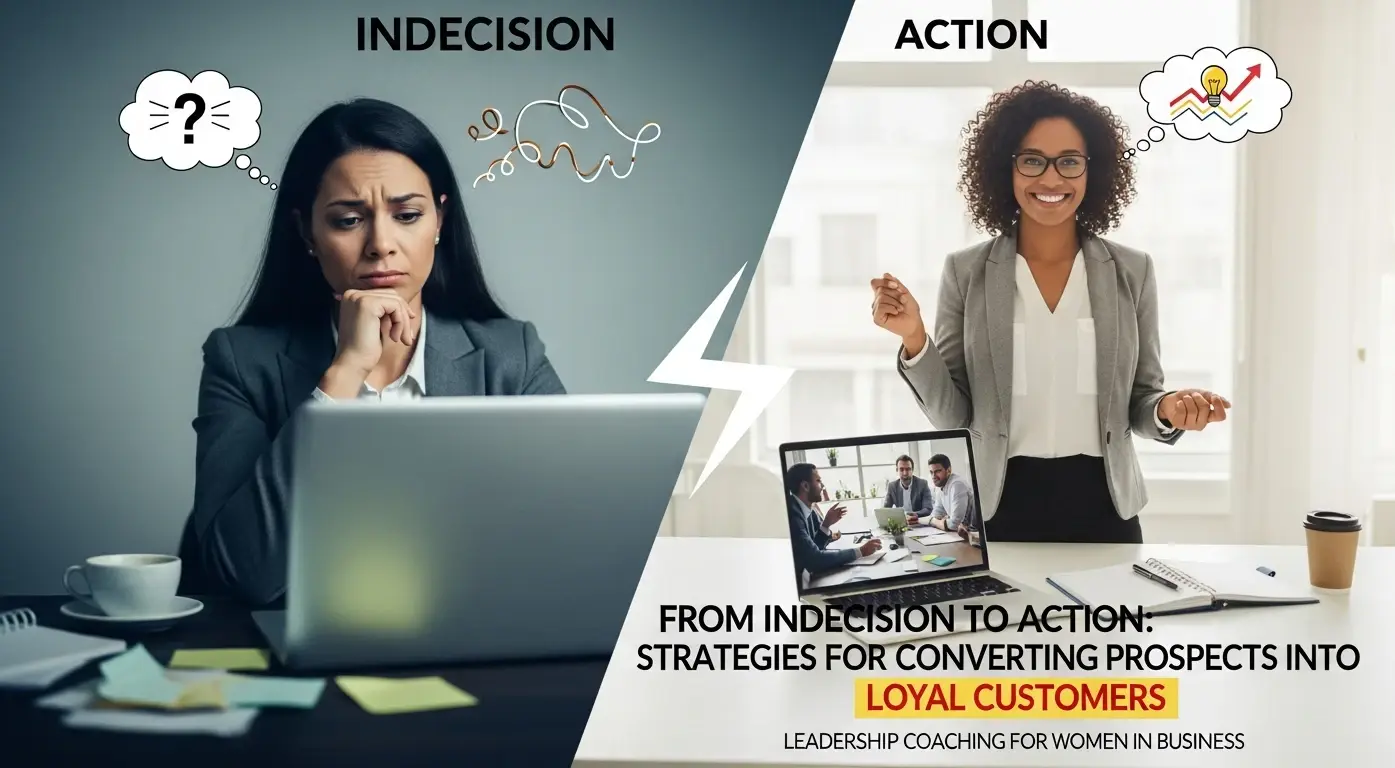
30 seconds summary
●From Indecision to Action: Strategies for Converting Prospects into Loyal Customers in Leadership Coaching for Women in Business; focuses on practical strategies to help women leaders overcome indecision and take actionable steps to turn potential clients into committed, long-term customers.
● Key approaches include building trust, offering tailored solutions, and creating value-driven relationships, nurturing ongoing communication, and leveraging social proof and testimonials to foster confidence.
● By aligning coaching services with the specific needs and aspirations of women in business, these strategies guide prospects through a seamless transition from interest to commitment, driving both business growth and personal empowerment.
Introduction
In the world of business, transforming prospects into loyal customers is a critical step that can determine long-term success and growth. For women in leadership roles, particularly in coaching, this transition from indecision to action is not just about offering a service, but about creating a connection that inspires trust, drives action, and fosters loyalty.
This article will explore strategies that women in business can employ to convert prospects into loyal customers, specifically within the context of leadership coaching for women. Through a combination of personal empowerment, targeted coaching strategies, and a deep understanding of customer needs, women leaders can turn potential leads into devoted clients.
The Landscape of Leadership Coaching for Women
Leadership coaching for women has experienced exponential growth in recent years, as many recognize the unique challenges and opportunities women face in leadership roles.
The need for personalized coaching tailored to women’s experiences in business is crucial. Women, particularly those in senior leadership positions, often face different expectations and barriers compared to their male counterparts.
These can include the glass ceiling, gender bias, and societal expectations around work-life balance. Leadership coaching helps women navigate these challenges by enhancing their confidence, decision-making abilities, and leadership styles.
Women in business who become leadership coaches often have the firsthand experience of overcoming these obstacles, making them uniquely qualified to provide the guidance and mentorship others need.
Yet, despite the growing demand for coaching, many prospects— potential clients—struggle with indecision, unsure whether coaching is right for them or if they’re ready to make the financial and emotional investment. This indecision presents a unique challenge for women in coaching leadership roles: how to convert these undecided prospects into loyal, long-term clients.
The Psychology of Indecision
Indecision can stem from various sources, but in the context of leadership coaching for women, it often arises from doubts about the value of the service, fear of failure, or uncertainty about their readiness for change. Many prospects may not fully understand how coaching can address their specific needs or may fear that coaching might not be worth the financial investment.
Additionally, they may be juggling other commitments or struggling with self-doubt and imposter syndrome, which are common feelings among women in business.
Understanding the psychology behind indecision is vital for leadership coaches, as it provides insight into how to communicate the value of coaching effectively. Prospects may not always be ready to commit because they need reassurance, confidence-building, or clarification about how coaching will meet their individual needs and goals.
Strategies for Converting Prospects into Loyal Customers
Build a Strong Personal Connection
The first step in moving prospects from indecision to action is building a strong personal connection. Leadership coaching is often a deeply personal experience, and clients need to feel seen, heard, and understood. Women in business who become coaches should invest time in cultivating authentic relationships with their prospects, listening to their concerns, challenges, and aspirations.
Effective coaches use empathy as a tool to understand where their prospects are coming from. Listening attentively and acknowledging the prospect’s struggles helps to build trust. Women coaches can relate to the personal and professional challenges that their clients face, which adds to the relatability factor. By demonstrating that they understand the unique challenges women in leadership face, coaches create a safe space where prospects feel more comfortable leaping into coaching.
Clarify the Benefits and Value Proposition of Coaching
Many prospects are indecisive because they don’t fully understand what leadership coaching entails and how it will benefit them. To convert prospects into clients, leadership coaches need to clearly communicate the value proposition of coaching.
A key strategy is focusing on results-oriented coaching. Instead of merely describing coaching sessions or processes, coaches should emphasize the tangible outcomes that clients will experience, such as improved decision-making, greater confidence, stronger leadership skills, or better work-life balance. Using testimonials, case studies, and success stories from previous clients can help illustrate these results and provide social proof.
Moreover, leadership coaches should highlight how coaching specifically addresses the unique needs of women in leadership. Whether it’s learning to navigate workplace gender dynamics, develop an authentic leadership style, or overcome imposter syndrome, focusing on these issues resonates with prospects who see these challenges as personal barriers.
Offer Free Discovery Sessions or Consultations
Indecision often arises from a lack of understanding or hesitation about the investment required. Offering a free discovery session or consultation is an effective strategy to give prospects a taste of what coaching will be like, without any pressure to commit right away.
During the discovery session, coaches can engage prospects in a conversation that identifies their key leadership challenges and goals. This provides an opportunity for the prospect to experience the value of coaching firsthand and see how the coach’s approach aligns with their needs. It also allows the coach to establish authority and build rapport, making it easier for the prospect to visualize themselves as a client.
Offering a free session or consultation creates an opportunity for the prospect to feel more confident in their decision-making process. It’s important that coaches use this time wisely, focusing on providing value while subtly guiding the prospect toward the realization that coaching is the solution they’ve been searching for.
Utilize Social Proof and Testimonials

Prospects often look for validation before making a decision, especially when it comes to investing in personal or professional development. Testimonials and social proof from previous clients can serve as powerful tools in addressing indecision.
Women in business who offer leadership coaching should gather testimonials from clients who have experienced significant growth and transformation. These testimonials should highlight not only the coach’s effectiveness but also how the coaching led to tangible business outcomes, such as career advancement, improved team dynamics, or greater self-confidence.
Social proof can also be extended to the coach’s own journey. Sharing personal stories of overcoming obstacles, imposter syndrome, or leadership challenges can help humanize the coach and make prospects feel like they are not alone in their struggles. It is through these shared experiences that prospects are more likely to trust the coach and make the decision to take action.
Create a Clear Call to Action
One of the main reasons prospects remain in a state of indecision is a lack of clarity about the next step. To combat this, leadership coaches must create clear and compelling calls to action that guide prospects through the decision-making process. A call to action should be simple, clear, and direct, whether it’s scheduling a session, signing up for a coaching program, or accessing more resources.
The key here is to reduce the friction for the prospect. If the process of becoming a client feels overwhelming or unclear, prospects may shy away from making a decision. Offering simple steps for getting started—such as an easy online booking system or a follow-up email after an initial consultation—can make the decision to commit to coaching feel more achievable and less intimidating.
Provide Continuous Value Through Content Marketing
Indecision is often driven by a lack of trust, or the feeling that the investment may not pay off. To alleviate these concerns, leadership coaches should focus on providing continuous value to their prospects. One of the best ways to do this is through content marketing. Offering free resources like blog posts, webinars, e-books, or online workshops can help prospects understand the coach’s approach and gain a better sense of what they would be getting in a coaching relationship.
By sharing valuable insights, tips, and strategies, leadership coaches can build credibility and trust with their audience. Additionally, offering educational content that addresses common pain points, such as managing stress, enhancing communication skills, or setting boundaries in leadership roles, gives prospects the tools they need to see immediate improvement in their personal and professional lives.
Continuous value provision builds the perception that the coach is genuinely interested in the success of their clients, not just in making a sale. This approach can ultimately turn prospects into loyal customers, as they feel that the coach is a valuable resource even before they commit to paying for services.
Nurture Long-Term Relationships with Follow-ups
Once a prospect has expressed interest in coaching but hasn’t yet committed, follow-up is essential. Many potential clients need time to make decisions, and a well-timed follow-up can be the nudge they need to move forward. However, follow-ups should never feel salesy or pushy; instead, they should be focused on continued support and encouragement.
A leadership coach can follow up with additional resources or check in on the prospect’s progress toward their leadership goals. This helps to keep the relationship alive and provides further evidence that the coach is invested in the prospect’s success. Personalized emails or messages that reflect an understanding of the prospect’s unique needs and challenges can also go a long way in building trust and encouraging action.
Conclusion
Converting prospects into loyal customers is a multifaceted process that requires understanding the psychology of indecision, building trust, and offering value at every stage of the customer journey.
Women in leadership coaching can employ a range of strategies, from personal connection-building to content marketing, to guide prospects from indecision to action. By emphasizing empathy, value, and continuous support, leadership coaches can not only turn prospects into clients but can also establish long-term, meaningful relationships that benefit both the coach and the client.
With the right strategies, women in business can not only thrive as leadership coaches but can also help others achieve their greatest potential.
Images courtesy of Pixabay, UnSplash, and Pexels.
Do you know that the more you use your brain, the better it is for you? AND, the more difficult it becomes to get ‘old’? Yup, the brain is really a ‘muscle’, and the more you ‘exercise’ it, the better and stronger it becomes. With that said, let’s see how we can make the brain better.
How about that second career? Ever thought about writing? Or even have someone write for you if you think this would be a better alternative. Well, how about creating your own website? Letting your voice be heard…without actually talking…but using words online. We all have a story within us…what’s yours?
The time is NOW, step out into the world of possibilities…do something different and discover new horizons. It is not difficult and certainly easy when you know the way to do it.
Let me introduce you to Wealthy Affiliate, the place where I learned how to create a website and ‘let my voice be known’. This is where I learned how to create my own blog and connect with people who helped me along the way.
Get your free hobby makeover guide I created to help you get started.
In it, I will tell you:
- how to create your first website and still have 25 FREE ones in addition
- choose a niche
- get a marketing strategy in place
- and of course, the best place to get started – for free – no credit card needed for the 7-day FREE trial membership.
When you learn how to create your own blog, you get to choose the things that you write about. You can also use the blog to make extra income.
Make Another Dream A Reality – Get Your FREE Hobby Makeover Guide TODAY – It is your motivation to make a new start in your life…no matter where you are – geographic location is NEVER a problem either, especially when you live the laptop lifestyle.










 Hello there, I am